Mission & Vision
My mission is to transform the way the world measures food, shifting the focus from calories to healthy diets.
Monitoring and ensuring access to adequate food was the seed of international collaboration. In 1945, the Food and Agriculture Organization (FAO) was the first agency of the United Nations to be established. Its work began with global food surveys to understand hunger and the food supply. Data led to action.
The way we define the problem influences the solutions we pursue. Today, we need broader information about the global food situation to understand how to address malnutrition in all its forms. Adequate food means more than adequate calories. Cost and Affordability of a Healthy Diet was first included in UN reporting in 2020. Diet indicators – what people actually eat – were first included in 2025 based on data from the Diet Quality Questionnaire (DQQ).
My vision is that these new indicators are routinely monitored globally and in countries, and that they lead to action.
Download Vision Paper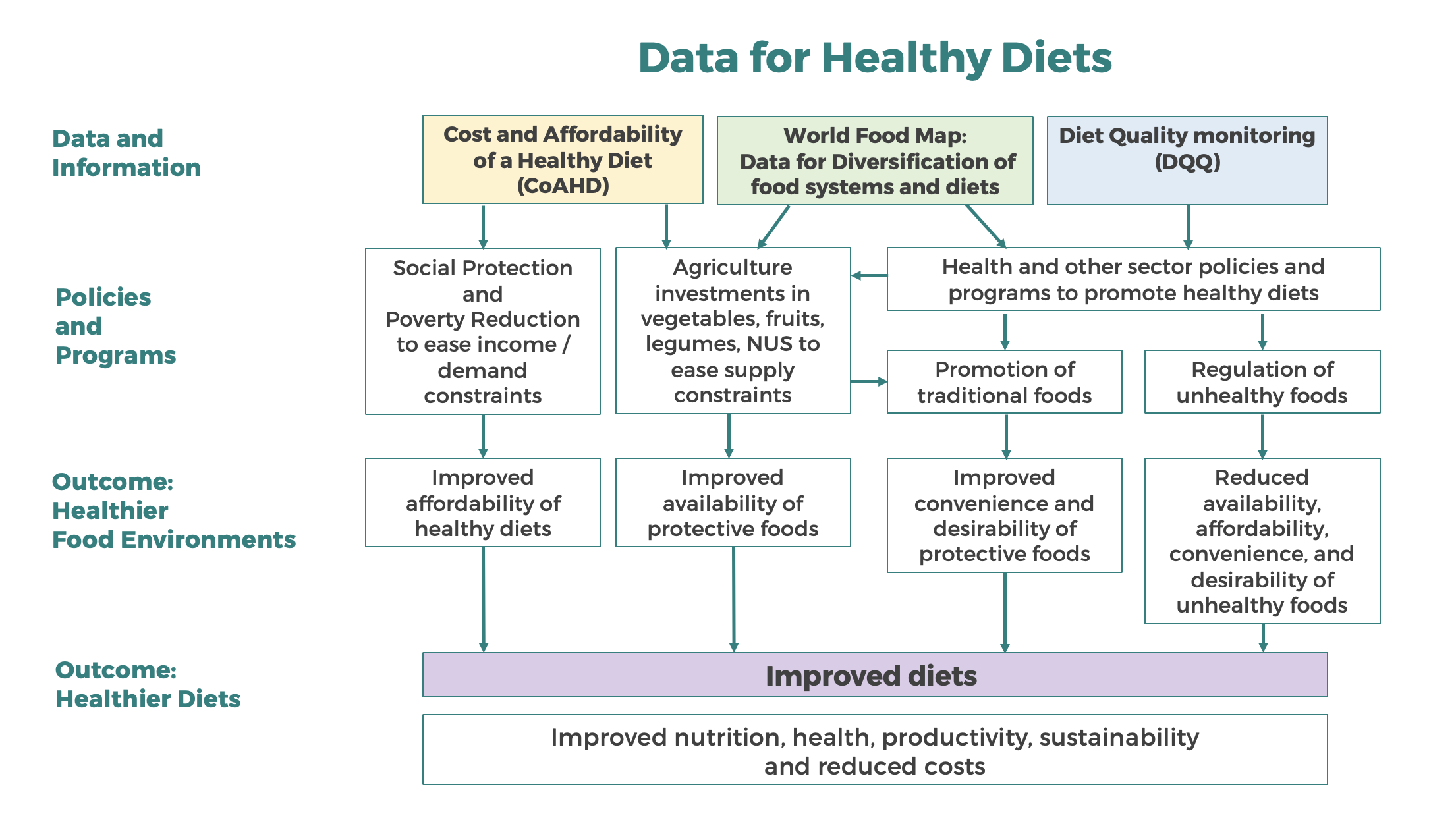
Actions for improved food access and healthy diets:
- Actions in agriculture to ease supply constraints for the foods most often missing in diets: vegetables, fruits, legumes, nuts.
- Actions in poverty reduction to ease income constraints to purchasing healthy diets.
- Actions in health to prevent the displacement of healthy traditional foods by unhealthy ultraprocessed foods.
- Community actions to promote the conservation and use of local biodiversity for healthy diets.
The World Food Map of global edible biodiversity shows how diets could be improved with locally available species that are culturally relevant, climate resilient, and nutritionally rich.
Why it matters to me
I feel a strong sense of purpose in linking agriculture and nutrition through statistics. My great grandfather was known to say, “First, get the facts.”
My great grandfather was a founder of the field of agricultural economics. His approach was price statistics and agricultural/ household surveys: he did some of the first farm surveys in New York State at the turn of the 20th century. Meanwhile, the women in my family studied home economics, both formally and informally. My great, great grandmother wrote an essay, “What shall we eat?” about how difficult it was to choose a healthy diet and feed all the children. It was not published. It was 1885.
The 20th century saw the development of the disciplines of agricultural economics and nutrition. The field of agricultural economics was concerned with prices of commodities and efficiency. Meanwhile nutrition was concerned with efficiency of a different sort: nutrition education, with implications for personal responsibility to make the most of every dollar in food purchases. Dietary guidelines were developed to provide people (mostly mothers) with information to help select healthy diets for the household. Statistics about food reflected globally traded commodities. At home, women made choices for their families with the resources they had. To keep the children alive and well.
Revolutionizing global statistics about food as healthy diets corrects the disconnect. The methods of my forefathers, the concerns of my foremothers. Through data, we make the invisible struggle visible. And we can start to see a different future where agriculture and food policy is based on an understanding of nutrition as a basic need.
A century of policy focus on traded commodities in agriculture has also, arguably, had the unintended consequence of hastening the homogenization of crops and the homogenization of diets. The same few crops that displace diversity in fields are used to mass produce ultra-processed foods that displace diversity in diets. What we eat is changing in tandem with what we grow and trade. “A body and a land are not two different things” (Korean proverb). Data on what people eat is essential to observe changes, and act accordingly.
I studied ethnobotany – how people use plants – as an undergraduate. The relationship between people and place via the connective tissue of plants is one of the things that makes us most human, that stretches as far back into our history as Homo sapiens go. Tell me what you eat, and I will understand the history of where you are from and who you are becoming.
If we are to heal our disconnect with the planet, we must first remember what it means to connect. Understanding what foods grow in each place, and how we in our myriad human languages call them, is vital information. Recall the very first priority of international collaboration: global food surveys, data to ensure our ability to eat. Mapping edible biodiversity is a necessity. It is also a celebration of the world, and humanity’s place in it.
First, get the facts. Then use the facts, and be well.