Measuring and improving global diets through data.

Thanks

First and foremost, I would like to acknowledge my collaborators and donors on these projects. All this has taken a village: a global community of thousands of collaborators, and committed donors willing to invest in our shared aims. I do not name them here, because properly acknowledging them all would take an entire additional website – or several. Accordingly, my collaborators, partners, co-authors, colleagues and donors who have made this work possible are acknowledged in each project website linked below. I am so grateful to you all.

Foundational Publications

Foundational Publication Banner

The year of my PhD graduation (2010), I gave birth and was thus rendered ineligible for (non-existent) maternity leave or sensible flexibility within a regular job. Thus, my unintended career as an independent woman-owned business began.

After a brief start at the World Bank where I helped launch the Scaling Up Nutrition movement in 2010, I worked for several international agencies as a consultant. I learned the landscape of the multilateral and bilateral development community, and was afforded many opportunities to explore and synthesize what agriculture could do for nutrition. I am grateful to this learning ground provided by the World Bank, FAO Nutrition Division, USAID (SPRING, FHI360, Advancing Nutrition), GIZ, DFAT, the UN SCN, and CGIAR, among others.

The outcomes of those years are summarized in the following foundational documents. They established my mission and vision.

1. Herforth A. 2015. Access to Adequate Nutritious Food: New indicators to track progress and inform action. In: Sahn, D (ed.), The Fight against Hunger and Malnutrition. Oxford University Press.

This is the most important document I have written. It proposed the Cost of a Healthy Diet, and regular monitoring of a suite of diet quality indicators reflecting minimum dietary diversity, protective food consumption, and unhealthy food consumption. This was the blueprint for my career. It took a decade, but the monitoring of these indicators has now been globally adopted within the UN.

Abstract:
New indicators are needed for global monitoring of access to and consumption of adequate nutritious food. These indicators would fill a basic information gap necessary to understand the causes of malnutrition, and to inform policy options to support food security and nutrition. Globally collected indicators of food security have remained virtually unchanged since the 1960s, largely derived from the single indicator of national-level dietary energy supply. This simple and unidimensional characterization of “food” was a guidepost toward pressing needs 50 years ago, but it is no longer adequate for the nutritional realities of today’s food systems, or the worldwide distribution of nutritional problems. Suggestions are made for how new indicators of food access and dietary quality can be mainstreamed in the nutrition and agriculture data sets and parlance, to shift the generalized construction of “food” from one of caloric adequacy to one of nutritious food to meet dietary needs.

2. Herforth A and Tanimichi Hoberg Y. 2014. Learning from World Bank History: Agricultural and Food-based Approaches for Addressing Malnutrition. Agriculture and Environmental Services Discussion Paper No. 10 Washington, DC ; World Bank Group.

In collaboration with the World Bank Archives, we scoured historical documents and interviews surrounding the work of the World Bank on poverty reduction and malnutrition reduction (conceptually closely linked from the start), over the 40 years from 1973-2013. The main finding was that while “food insecurity and malnutrition” were frequently cited as justifications for work in agriculture, these outcomes were not measured within any project impact. Methods and metrics to measure them in a way that made sense for agriculture did not exist. Food security and nutrition were generally considered synonymous with food supply and income.

“If agriculture is to respond to a different problem than lack of calories and income, then there is a need to collect and report data on the problem that needs to be solved... The food shortage paradigm, appropriate in the 1970s, no longer fits today’s data, which show stronger evidence of a nutritious food shortage.”

3. Herforth A, Ahmed S. 2015. The food environment, its effects on dietary consumption, and potential for measurement within agriculture-nutrition interventions. Food Security 7(3): 505-520.

This paper articulated the food environment and why it shapes diets in low- and middle-income countries. It built on previous food environment literature to apply the concept beyond high-income countries, and detailing how the food environment is shaped by agriculture. We defined the food environment as the availability, affordability, convenience, and desirability of food items. These aspects could be monitored using a set of indicators.

4. Herforth A, Arimond M, Alvarez-Sanchez C, Coates C, Christianson K, Muehlhoff E. 2019. A global overview of food-based dietary guidelines. Advances in Nutrition, nmy130.

This paper was written to understand the commonalities and differences across dietary guidelines, shortly after FAO assembled them in a global repository. We identified aspects of implicit consensus that laid the groundwork for both the Healthy Diet Basket (the nutritional standard for measuring Cost and Affordability of a Healthy Diet), and diet quality indicators of adherence to dietary guidelines.
Improving Nutrition through Agriculture

We started this group in 2010 as five individuals in the Washington, DC area, all tasked with writing institutional documents on multi-sectoral strategies for nutrition, following the launch of the Scaling Up Nutrition movement and its call for nutrition-sensitive agriculture. We began meeting with the aim of harmonizing our messaging on nutrition-sensitive agriculture, so that our shared voice would speak clearly across institutions, avoiding competition and confusion. This Agriculture-Nutrition Community of Practice (Ag2Nut) soon grew exponentially, and monthly meetings and resources were hosted first ad hoc, then by USAID's SPRING project, then by the new Agriculture Nutrition and Health (ANH) Academy.

  • Ag2Nut grew from 5 members from 1 country to more than 9,500 members in 130 countries in its first decade.
  • We host an active email list-serve, and a website at www.ag2nut.org
  • We produced a 2-page consensus statement in 2013 that was later adopted by FAO in 2015: Key Recommendations for Improving Nutrition through Agriculture.
  • Because the "Key Recommendations" were produced by all members, they were widely used to design nutrition-sensitive agriculture projects in many UN, bilateral, and civil society organizations. Examples:
    • They were incorporated into USAID’s Multisectoral Nutrition Strategy 2014-2025.
    • A 10-year, $330 million Global Programme for Food and Nutrition Security and Enhanced Resilience in 12 countries was designed and evaluated around the Key Recommendations.
    • They have been used for staff trainings by GIZ, USAID, DFAT, and non-profit organizations including ACF and World Vision.
    • They were used as an analytical framework to assess policies, programs, and grant applications for their nutrition sensitivity.
    • It was commended as one of FAO's most valuable knowledge products in a 2019 external evaluation of the Strategy and Vision for FAO’s Work in Nutrition.

The blueprint for Ag2Nut was the Food, Agriculture, and Nutrition Group (FANG) that I established as a graduate student at Cornell University in 2007 to help link students and faculty across the Agriculture school and the Human Ecology school.

Key References

  1. FAO. 2015. Key Recommendations for Improving Nutrition through Agriculture.
  2. FAO landing page for nutrition-sensitive agriculture:
    1. FAO. 2015. Designing Nutrition-Sensitive Agriculture Investments: Checklist and Guidance for Programme Formulation.
    2. FAO. 2016. Compendium of nutrition-sensitive indicators in agriculture.
  3. Herforth A, Ballard T. 2016. Nutrition indicators in agriculture projects: Current measurement, priorities, and gaps. Global Food Security 10:1-10.

Monitoring the Cost and Affordability of Healthy Diets

FAO CoAHD Landing Page

2015-2025

The UN defines food security as having “physical, economic, and social access to sufficient, safe, nutritious food to meet dietary needs and food preferences for an active and healthy life.” In other words, access to healthy diets.

In 2015, I wrote a grant for a 2-year project, Indicators of Affordability of Nutritious Diets in Africa. This grant opened up the space to work on developing the Cost of a Healthy Diet and indicators to track the cost of food groups, to reflect economic access to healthy diets. From the start, our work was with national governments, with the vision that these metrics would be used for policy decision-making toward improved access to healthy diets. This early work with data collectors showed how existing food price monitoring systems could be leveraged to understand the retail cost of meeting dietary guidelines.

The initial success grew into a 10-year project, Food Prices for Nutrition, which I co-directed as a collaboration of Tufts University, IFPRI, and the World Bank. We used food price data from the International Comparison Program to calculate the cost of meeting dietary guidelines in each country, and data from the Poverty Information Platform to estimate the number of people who could not afford it (Herforth et al. 2020). These results were published in the 2020 edition of the State of Food Security and Nutrition in the World report. In 2022, FAO formally adopted the indicators Cost and Affordability of a Healthy Diet and established the series in FAOSTAT. The World Bank simultaneously publishes the indicators in the World Bank DataBank.

We continued to work with national governments, focusing efforts in five countries. In Nigeria, this monitoring swiftly led to a historic increase in the minimum wage. People successfully argued that they needed to be able to eat.

2026–

I am a Senior Adviser to the FAO Statistics Division. Our work is to institutionalize, within FAO, support to countries for monitoring the Cost and Affordability of a Healthy Diet for policy action. We have a grant to support 10 countries and establish global guidance on methods (2026-2029).

Key References

  1. Herforth, A., Y. Bai, A. Venkat, K. Mahrt, A. Ebel & W.A. Masters. 2020. Cost and affordability of healthy diets across and within countries. Background paper for the State of Food Security and Nutrition in the World 2020. FAO Agricultural Development Economics Technical Study No. 9. Rome, FAO.
  2. CoAHD methods:
    1. Herforth A., Venkat A., Bai Y., Costlow, L., Holleman, C., Masters W.A. 2022. Methods and options to monitor the cost and affordability of a healthy diet globally.
    2. Bai, Y., Conti, V., Herforth, A., Ebel, A., Cafiero, C., Rissanen, M.O., Rosero Moncayo, J. & Masters, W.A. Methods for monitoring the cost of a healthy diet based on price data from the International Comparison Program.
    3. Bai, Y., Herforth, A., Cafiero, C., Conti, V., Rissanen, M.O., Masters, W.A. & Rosero Moncayo, J. 2024. Methods for monitoring the affordability of a healthy diet.
  3. Herforth A.W., Bai Y, Venkat A, Masters WA. 2025. The Healthy Diet Basket is a valid global standard that highlights lack of access to healthy and sustainable diets. Nature Food, 6, 622–631.
  4. Mahrt, K., A.W. Herforth, S. Robinson, C. Arndt, S. Headey. 2022. Nutrition as a Basic Need: A new method for utility-consistent and nutritionally adequate food poverty lines. IFPRI Discussion Paper.
  5. Herforth A.W., Gilbert R, Sokourenko K, Fatima T, Adeyemi O, Alemayehu D, Arhin E, Bachewe F, Bai Y, Chiosa I, Genye T, Haile H, Jahangeer R, Kinabo J, Mishili F, Nnabugwu CD, Nortey J, Ofosu-Baadu B, Onabolu A, Sarpong D, Tessema M, Van DTT, Venkat A, Masters WA. 2024. Monitoring the Cost and Affordability of a Healthy Diet within countries: Building systems in Ethiopia, Ghana, Malawi, Nigeria, Pakistan, Tanzania, and Viet Nam. Current Developments in Nutrition.

Measuring What the World Eats

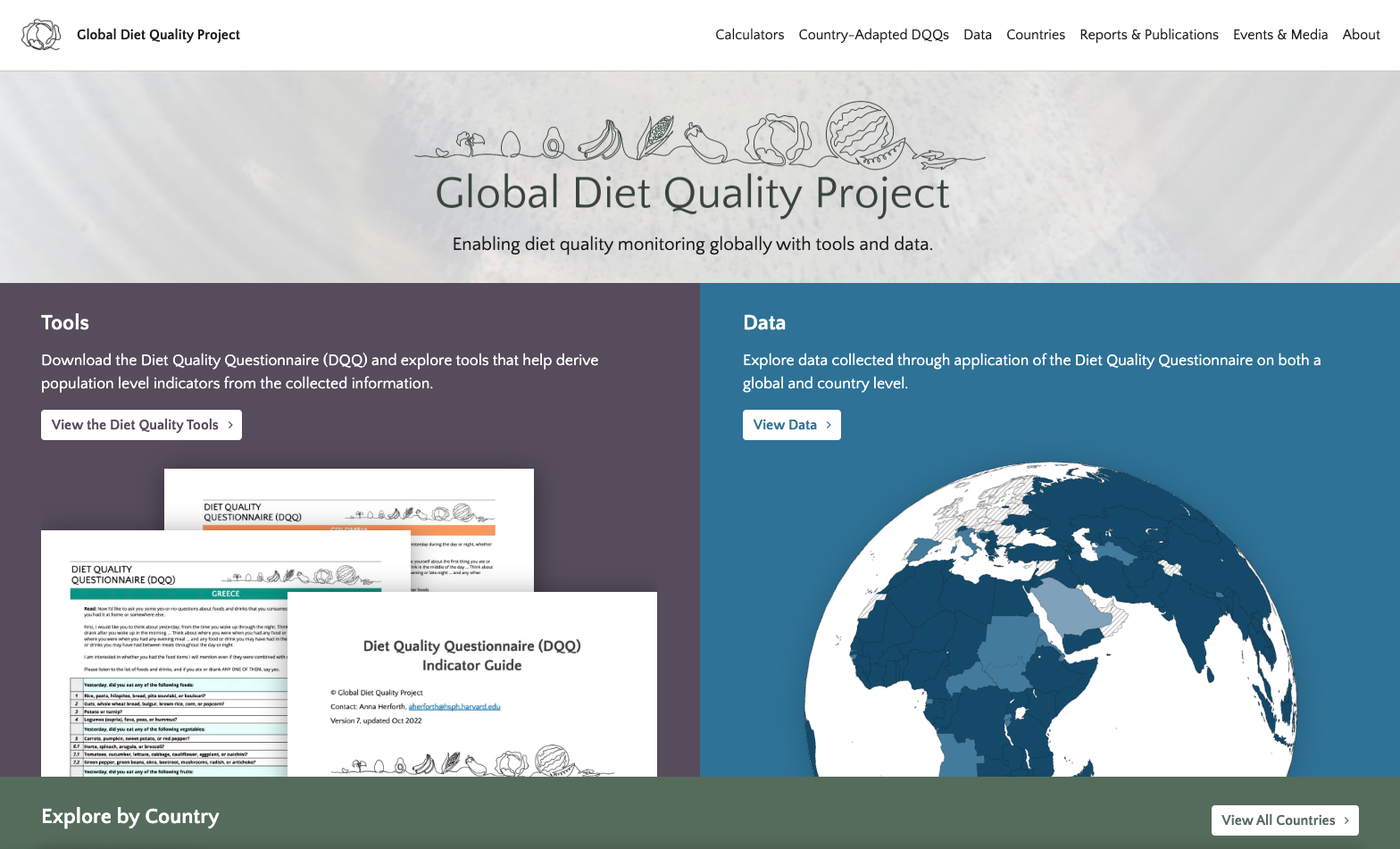
GDQP Global Diet Quality Project
GDQP Logo

2016-2025

The Global Diet Quality Project began in 2016 with the simple question, “Why don’t we collect data on diets across countries?”

Over the next decade, we developed a robust, replicable methodology for feasible, low-cost diet data collection.

  • The diet quality questionnaire (DQQ) was adapted for each country, through an inclusive process involving 1,000 key informants in 140 countries, whilst adhering to the global guidance documents for data collection published by FAO, WHO, and UNICEF.
  • The DQQ has been implemented in over 100 nationally-representative surveys since 2021.
  • The DQQ can be administered by generalist enumerators, and the cost is equal to 5 minutes of survey time. Data analysis is automatic.
  • I worked directly with the Gallup World Poll, the Demographic and Health Surveys (DHS), and the Living Standards Measurement Study (LSMS) to provide harmonized questionnaires, averting fragmentation in data collection.
  • By 2025, this investment resulted in the first ever diet indicators in:
    • Sustainable Development Goals (SDGs): Minimum Dietary Diversity (MDD).
    • WHO’s results framework: % of the population aged 15+ consuming a healthy diet pattern.
    • UNICEF’s child nutrition report, to include data on adolescents.

I was the Principal Investigator of the Global Diet Quality Project at Harvard T.H. Chan School of Public Health (Global Health and Population Department) through the completion of our multi-donor funding in 2025. The project was a collaboration between Gallup, Harvard, and the Global Alliance for Improved Nutrition (GAIN).

2026–

I continue the work of enabling diet quality monitoring in two ways:

I am a Senior Adviser to the WHO Nutrition and Food Safety Department. Our work is to support the use of diet data for design and impact of healthy diet policies. This remit falls within the Global RECAP program (2025-2029).

I maintain the work of the Global Diet Quality Project as a consultant, and as a Visiting Associate Professor at Wageningen University & Research. In collaboration with the World Bank LSMS, I will prepare guidance on Best Practices for implementing the Diet Quality Questionnaire in Household Surveys. Additional funds are needed to meet the demand for technical assistance.

Key References

  1. Global Diet Quality Project. 2021-2024. Diet Quality Questionnaire adapted for 140 countries.
  2. Herforth, A.W., Ballard, T., and Rzepa, A. 2024. Development of the Diet Quality Questionnaire (DQQ) for measurement of dietary diversity and other diet quality indicators. Current Developments in Nutrition.
  3. Herforth, A.W., Sokourenko, K., Gonzalez, B.C., Uyar, B.T., Bulungu, A.L. and Vogliano, C., 2024. Adaptation of the Diet Quality Questionnaire as a global public good for use in 140 countries. Current Developments in Nutrition.
  4. Herforth, A.W., Sattamini, I.F., Olarte, D.A., Diego-Rosell, P. and Rzepa, A., 2024. You say potato, I say vegetable; you say tomato, I say fruit: Cognitive validity of food group-based dietary recall questions. Current Developments in Nutrition.

Mapping the World’s Edible Biodiversity

World Food Map Biodiversity

Our aim is to showcase the world’s edible biodiversity, and show how diets could be improved with locally available species that are culturally relevant, climate resilient, and nutritionally rich.

2021-2026

The World Food Map began as a simple visual display of the most commonly consumed foods in each country, organized by food group. It grew out of the Global Diet Quality Project, which had conducted over 1,000 key informant interviews in 140 countries for the purpose of developing valid questionnaires for diet quality data collection for each country. As collateral benefit, these interviews produced the first systematic identification of the most commonly consumed foods around the world. Our scope grew to include neglected and underutilized species, and an objective to inspire investment in more diverse, climate-resilient foods to improve healthy diets.

We will soon will release an updated map to display:

  • Enhanced item information:
    • Robust scientific identification of each commonly consumed food item, including translations into local languages and photos of each item.
    • Expanded information on each species including where each species is grown or harvested, where it could be grown based on (changing) climate, botanical identification, agronomic traits, genebank holdings and conservation status (for plants), and sustainability (for aquatic foods).
  • Past: centers of origin of crops, suggesting where the richest biodiversity still exists for each species.
  • Present: use of dietary data from the Global Diet Quality Project to identify dietary gaps.
  • Future: Identification of common and underutilized species that can fill dietary gaps.
  • Stories of food showcasing information about history, knowledge, promotion, or policies related to specific foods to inspire action.

The project is based at Wageningen University & Research. The map has benefited from data inputs from a wide range of collaborators: the Alliance Bioversity/CIAT, Botanical Gardens Conservation International, Crop Trust, Crops for the Future, the Global Diet Quality Project, IDLO, IDRC, IFAD, the International Treaty on Plant Genetic Resources for Food and Agriculture, Kew Gardens and the New York Botanical Garden with the University of Torino, the Periodic Table of Food Initiative, Seafood Watch, and the World Wildlife Federation; along with numerous individuals who are contributing Stories of Food.

2026–

The World Food Map aims to support the Global Conservation Consortium for Food Plants (GCCFP) to convene a network of those who are already working to conserve and revitalize local biodiversity, and to integrate their efforts into countries’ Agriculture and Health strategies.

We envision a collaborative network (Biodiversity for Wealth and Health) that strengthens entrepreneurship to create economic opportunities for the use of underutilized species to support healthy diets. We will work in collaboration with PTFI to apply expanding knowledge about the bioactive components of food.

We will work in coordination with the Global RECAP program under its strategic objective of healthy lives and well-being for all, including data, advocacy, regulatory and social mobilization efforts to prevent and manage non-communicable diseases.

Key References

  1. Ahmed S, Herforth A. 2013. Future Food: Use Local Knowledge. Nature 499: 409.
  2. Herforth A, Johns T, Creed-Kanashiro H, Jones AD, Khoury CK, Lang T, Maundu P, Powell B, Reyes-Garcia V. 2019. Agrobiodiveristy for Feeding the World: More of the same will result in more of the same. In: Ernst Strüngmann Forum on Agrobiodiversity in the 21st Century.
  3. van Zonneveld M, Khoury CK, Herforth AW, Vogliano C, Fowler C, Gora S, Azevedo V, Krishnan S, Meleisea Waqainabete L, N'Danikou S, Schranz E. 2025. Reversing vegetable biodiversity loss to diversify diets.